My Backpacking Gear List
Dear reader: this article contains links to products and services that I may be compensated for, at no extra cost to you.
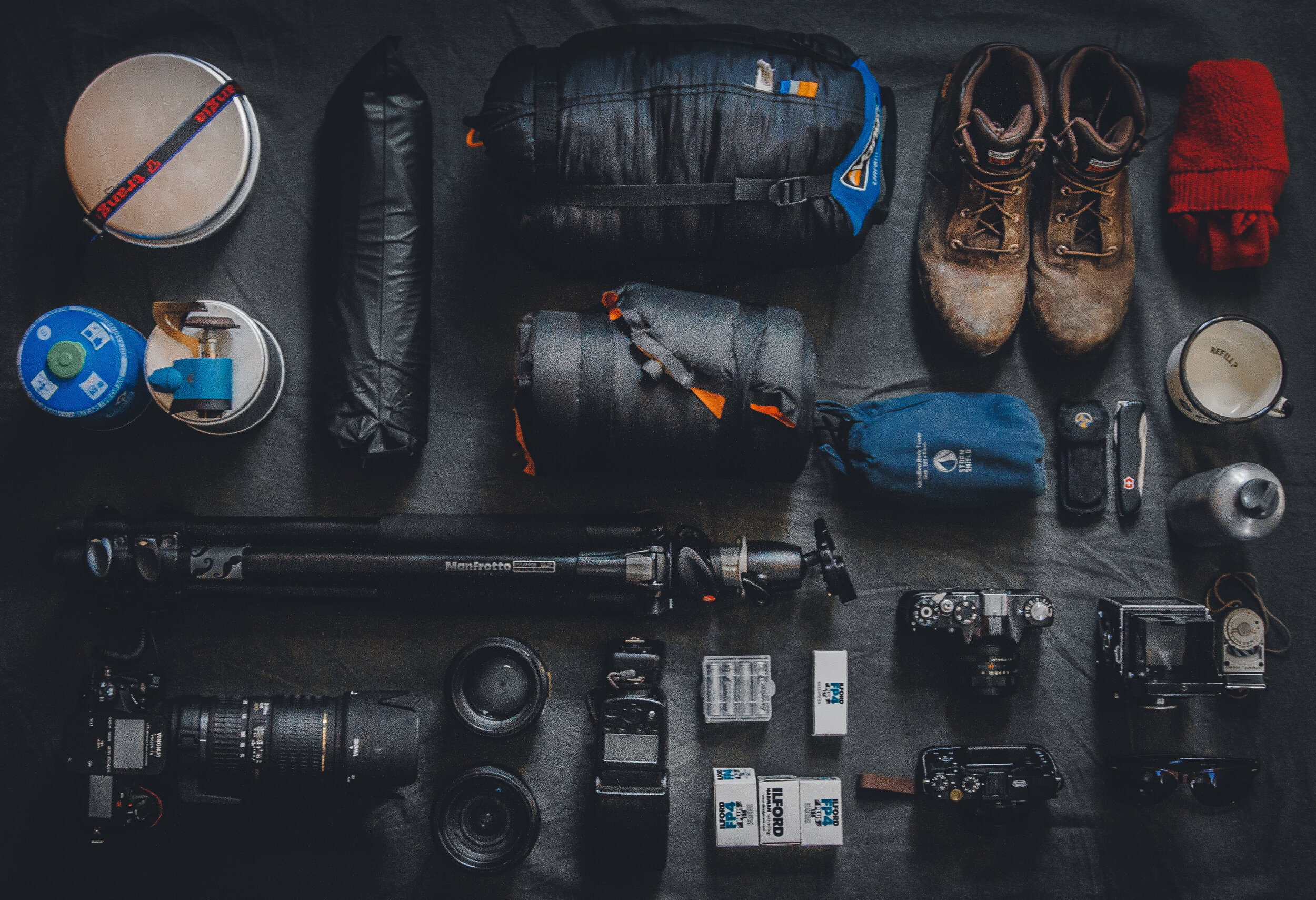
All of the gear I use for backpacking in 2020
Backpacking in the mountains can provide one of the purest forms of happiness in our lives. The ability to get out of the city, the stresses of life, to be surrounded by nature and immersed in its tremendous beauty is a wonderful luxury we can all enjoy. It feels this year, more than ever, a backpacking trip to the mountains is sorely needed.
I’m often asked for recommendations on what to bring for day hikes to high mountain climbs, and everything in between. I’ve put together my gear list for overnight backpacking trips. I hope these can help you get a gear pack started, or help you refine what you already have for backpacking your hometown mountains and beyond!
In general, it is important to have these items when backpacking in the high mountains:
Lightweight Tent
Tarp
60L or more Backpacking Pack
Sleeping Bag
Sleeping Pad
Stove and Fuel
Utensils
Food
Water and Water Treatment Tools/Tablets
First Aid Kit
Hiking Boots or Shoes
Appropriate Hiking Attire
Rain Jacket and Warm Clothing
Lightweight Day Pack
On top of this list, you should absolutely have the TEN ESSENTIALS:
Knife - very necessary
Headlamp - bring extra batteries
Navigation - compass, map, GPS device
Sun Protection - hat, sunglasses, sunscreen, etc
First Aid Kit - include foot care and insect repellant
Fire - matches, lighters, flint, stove
Shelter - tarp or emergency bivy
Extra Water - beyond minimum expectation
Extra Food - beyond minimum expectation
Extra Clothing - beyond minimum expectation
Alright, now that we have the basics under our belt, let me show you what I bring to the mountains on any given trip. Of course, this list can be adjusted depending on how many days I’ll be in the mountains, or how difficult the hiking will be. Let’s get to it! My typical backpacking gear for 2020!
Backpack
What I love about the F Stop Gear Sukha Pack is that it is large enough to fit all of the camera gear I would normally bring on an overnight camping trip in the high mountains (see below), because of the ICU’s that keep everything neatly packed inside. With those ICU’s I am also able to bring my tent, sleeping bag, sleeping pad and any food/cookware that’s necessary.
This is a photography bag for the adventurer. They live up to that. I’ve taken my Sukha pack all over the high mountains of Taiwan, and will even use it on day trips because of how nice and neat everything packs inside.
Camping Gear
Kelty Salida 2 Person Backpacking Tent
I have taken this tent up in the high mountains of Taiwan backpacked with it in California and slept very comfortably every time. This Kelty tent fits two people comfortably, and is only 3lbs 14oz. The Kelty Salida backpacking tent comes with a pouch to fit the poles, rain fly, and tent neatly inside. This helps keep everything tightly packed in my backpack, and protects my other gear from the water and dirt that may accumulate on my tent overnight.
This tent has been on countless adventures and has held up spectacularly.
For friends and clients, I have a handful of Quechua two person tents that are very good for very cheap. They don’t pack as conveniently, but they can be attached to the outside of your backpack easily enough.
This isn’t fancy, but it does the trick and is lighter than a feather, weighing only 200 grams. This sleeping pad is also incredibly cheap. You can buy it at Decathlon for 200 NTD (~$7 USD). They have Alu film on the sleeping surface to help against abrasions and to increase thermal insulation. For backpacking, this has worked wonders.
My choice in sleeping bags is based on what’s easily available here in Taiwan. Typically I’ll bring sleeping bags from Decathlon, or from a local outdoor shop, Prince Outdoors, here in Taipei City. Which backpack you choose will heavily depend on the season, weather and elevation of your backpacking trip to the mountains. In the high mountains, above 3,000 meters elevation, I bring with me a -10 C tolerant sleeping bag. In the summer I’ll bring my…
This comes in handy on so many occasions. I always bring this to the high mountains, or to normal camp trips. The down blanket stuffs into a malleable pouch, so it doesn’t take up much room at all in the bag, and is very lightweight. I use it as a pillow while its in the stuff sack, and it greatly improves the quality of my sleep!
If the night is too cold, I can stuff the inside of my sleeping bag with this as well, and I’m good to go. Conversely, if I am hammock camping in the summer I will sleep on top of this and the blanket will keep my back from getting too cold at night.
Sometimes this down blanket is enough to keep me warm all night, and I can skip bringing a sleeping bag with me.
I wouldn’t bring my hammock to the high mountains, due to the lack of trees to hang it from, but I love hammock camping in lower elevation forests. It’s lightweight, easy to pack, and extremely comfortable to sleep in. One downside is no mosquito net, but I combat this by wrapping the hammock around me, like a cocoon.
I also bring my ENO Double Nest hammock when I intend to sleep in my tent. If the camping trip is more casual, I love throwing the hammock up and reading a book while laying amongst the trees. Sometimes there’s no better way to spend a day.
So there you have it! This is just about all the gear I use while camping and backpacking in the mountains and forests of Taiwan. This doesn’t even cover my camera gear that I bring with me on every trip as well!
Get out and enjoy the outdoors, always Be Adventurous!
Check out more photos on my Instagram!


Ancient Tree Groves of Smangus and Zhenxibao

Deep in the mountains of Hsinchu you can find Taiwan’s most remote indigenous village. At 1500 meters elevation, Smangus (司馬庫斯) has had an air of mystery surrounding it for many years. The Atayal village is known as a leader in community based tourism, keeping their authentic culture intact while only opening up to tourists in 1995,when the road to the village was first built. I recently had the chance to return to Smangus’ Ancient Tree Grove, as well as the Zhenxibao (鎮西堡) Ancient Tree Grove with OwlTing Experiences for a weekend of hiking, culture, and relaxation.
Getting to Smangus (司馬庫斯)
The day started early, as we were meeting outside Banqiao Train Station at 7am. This is necessary if you want to hike the Smangus Ancient Tree Grove on the same day as your arrival.
We took a couple vans, with hired drivers, up to the mountain villages. The drive from Taipei is roughly 3.5 to 4 hours, and once in the mountains the roads can get a bit dicey. I did notice that the roads seem to have been paved recently, and have improved greatly from my last trip here a few years ago. Back then I wouldn’t recommend driving yourself, but now it’s definitely possible.
Smangus Ancient Tree Grove
The Hike
Once we arrived, we were able to hike at our own pace, or as the group leader says, we were treated as fellow mountaineers. This was a welcomed surprise, because this was my first time being in a group of strangers where I wasn’t leading. I was worried I would have to follow in a line and not have the freedom to roam, take photos, etc. Thankfully not the case!
Last time I was here it was Autumn, so the vibe of the forest was completely different. This time, in the summer, the greens were so vibrant, the streams were full, and the threat of summer rain was real!
The Smangus Giant Tree Trail begins at the beautifully built restaurant cafe, which overlooks the mountains and valley below. The hike to the ancient tree grove is 5km, along a relatively flat trail. Possibly the most famous aspect of the trail, other than the ancient cypress trees, is the initial bamboo forest you hike through.

The towering bamboo shoots up, converging above to let slivers of sunlight through the creaking stalks. It’s definitely a beautiful experience, and there are ample hand crafted benches to sit down and soak it up.
Continuing down the trail the forest opens up a bit and you’ll have some views of the valley and surrounding mountains. The trail continues through gorgeous broadleaf forests, at a moderate level.

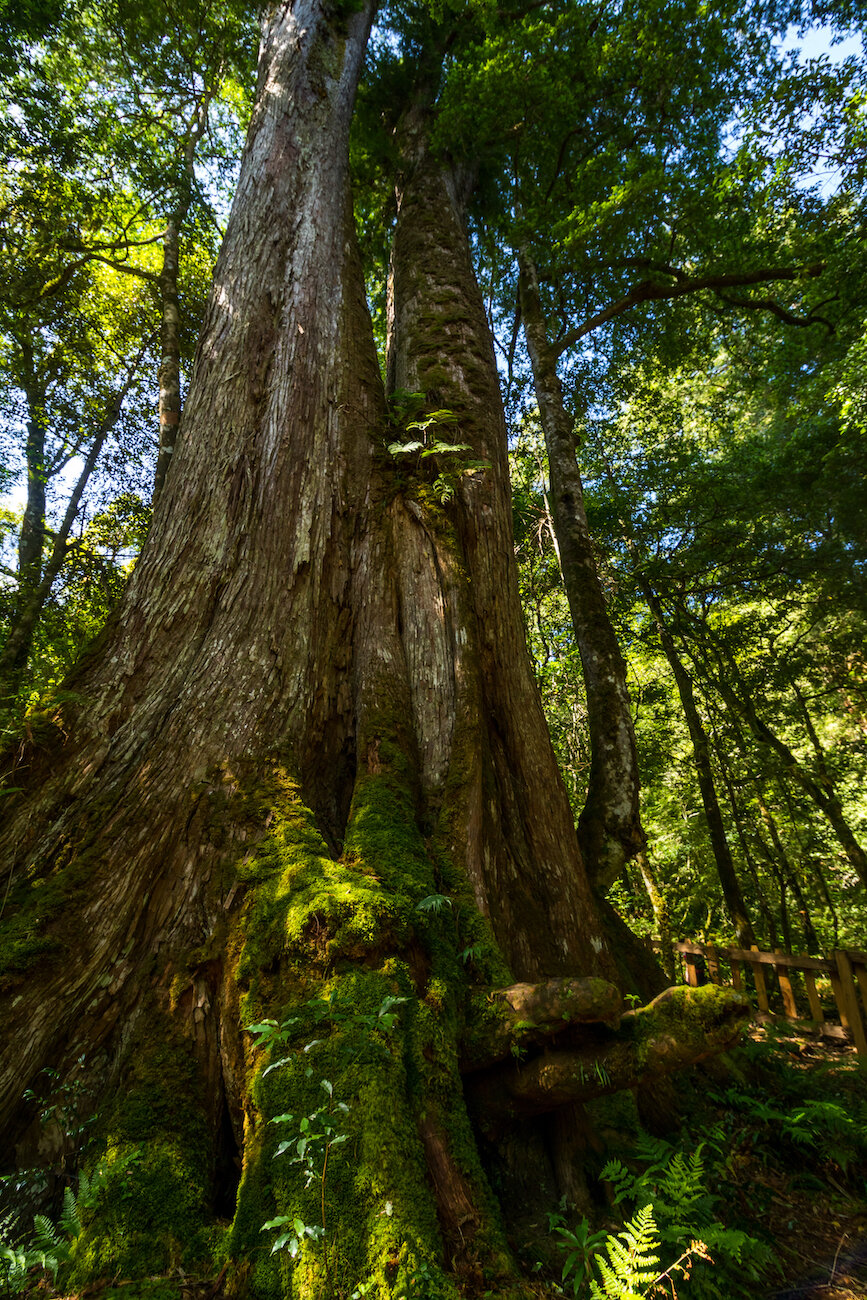
After 5km of hiking you will reach the Ancient Tree Grove! This little pocket of forest meanders in a circle around beautiful streams and thousand year old cypress trees. Due to the summer rains, the forest was beautifully damp, giving the ferns, and other flora a particular vibrance that is just enchanting.

The largest tree in Smangus’ grove is the third largest tree in Taiwan, with a base about 16m in diameter.

After exploring the grove, and taking in the massive thousand year old red cypress trees, I headed back to the village before the thunderstorm arrived.

The Village
We didn’t spend the night in the main Qalang Smangus, but we drove over to the other side of the valley to stay closer to Zhenxibao forest, in Xinguang (新光). The drive from the Smangus tree grove trail takes about an hour over the winding mountains roads.
Before heading to our homestay accommodation for the night, we got to take part in a special indigenous Atayal song and dance, as well as make mochi. An old woman, dressed in traditional clothing sang to us, as we rhythmically clapped along. She, her daughter, son, and grandchildren then all taught us how to dance along to the song. The mood was magical. We all listened to the beautiful singing voices of the grandmother and father, and the little boys try their best to be singing stars.
After the singing and dancing, we all got to pitch in and make mochi together. This involved holding a massive club and pounding the sticky rice while the elder used a stick to flip the sticky rice over in between poundings. We all had a chance to pulverize the sticky rice into that sweet mochi. The club itself isn’t so heavy, but it feels super glued to the rice when you try to pry it free for another round.

After many rounds, we got to taste the delicious, freshly made mochi. Roll it around in a pile of ground up peanuts, and pop it in the mouth!
We spent the night in a shared room homestay, and prepared for the next day’s hike through Zhenxibao forest. Before bed though, I noticed how clear the sky was and decided to go take some photos. Even without the camera, the Milky Way was visible! It was so incredible, I couldn’t remember the last time I saw the Milky Way in the night’s sky like that.

Cinsbus Giant Tree Trail
The Hike
We had a 7:00am breakfast, then we were off to Zhenxibao’s Cinsbus Giant Tree Trail. This hike is more difficult than Smangus’ Ancient Tree Grove, but not by all that much. The trail is a bit longer, roughly 13km round trip, and passes by many more thousand year old red cypress trees. The trees through this forest are a bit more distinct, with the more famous trees known as “Adam,” “Eve,” and “The King.”
The trail begins in the dirt car park and climbs up a gradual incline for a few kilometers, weaving through beautiful mossy trees and over running streams. The early morning sunshine is peaking through the forest, illuminating the leaves in a spectacular way. The birds are active, chirping and jumping from branch to branch, seemingly following us on the trail as we hike.

I went ahead of the group, hiking at a faster pace. I’m always keen to really hear and feel the sounds of the forests, and sometimes that isn’t possible when others are around you.
There’s a junction along the trail, with one route going up to the more strenuous Grove A, and eventually to Poison Dragon Pond (毒龍潭). The most popular is Grove B, because it has far more ancient cypress trees and is a bit more moderate of a trail to hike. We went to Grove B, which allows for a really beautiful hike at a nice pace.
Along the circular trail of Grove B are the famous thousand year old cypress trees. Adam and Eve, named because of their similarities to certain biological features, are each over a thousand years old. The oldest in the grove, and I think the most impressive, is called The King. This tree dates over 2,500 years old!

Overall, the whole forest of Cinsbus is impressive. The ancient cypress trees are abundant, and the hiking is not so strenuous as to take away from the beauty of the area. I truly recommend this trip to explore Smangus and Zhenxibao. It is a fantastic escape to authentic indigenous culture and some of Taiwan’s fairytale-like forests.


FOR THIS FUN TRIP AND MORE EXPERIENCES LIKE IT, CHECK OUT OWLTING EXPERIENCES
Kayaking Along the Qingshui Cliffs

In the last few months I have explored the Qingshui Cliffs from the Pacific Ocean twice as many times as I have in the five plus years living in Taiwan. That is to say, I’ve been two times in the last few months, once by SUP and most recently by kayak. I’m going to recount my kayaking trip along the cliffs with OwlTing Experiences, but if you’d like to see more about SUP, read this.
My day started at 3am, which is always rough, but I’m used to it from my mountain trekking experiences. As I’ve always said, you have to earn a sunrise!
I was staying at my go to hostel in Hualien, the Lazy House, and this time had the comfort of knowing I would be picked up by my kayak guide at 3:30 am. So I walked down the street to 7-11, got a coffee, and relaxed outside and waited. So far the easiest attempt at viewing sunrise thus far.
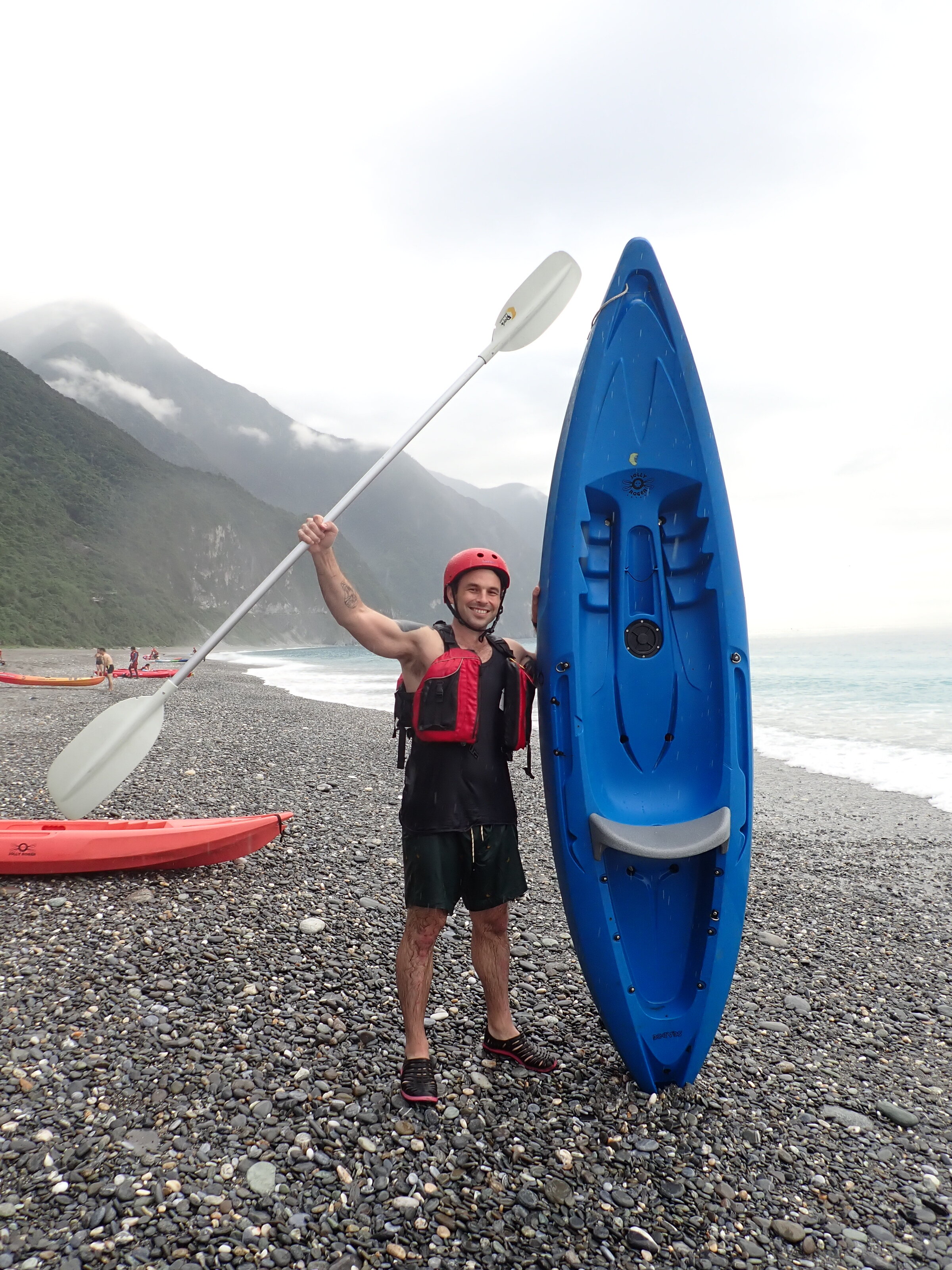
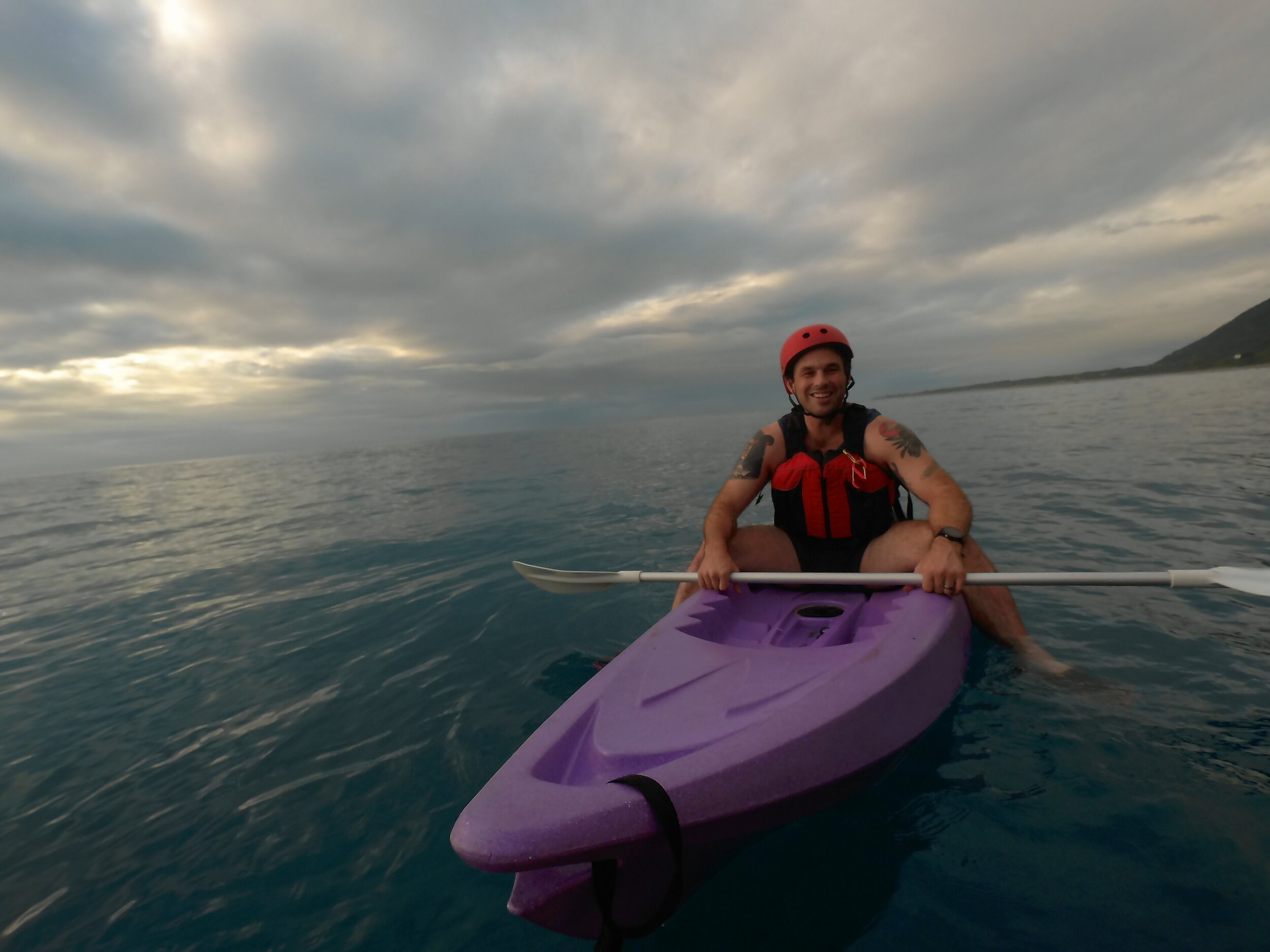
My guide Liber, from Moonyak, picked me up and he brought me to get suited up with a helmet, water shoes, and a lifejacket. I went through some brief instruction on paddling a kayak, and I was off! We drove to the beach at Chongde and waited for the perfect opportunity to get in the water. There were a ton of other groups out there this morning, larger parties and people who seemingly had less experience on the open water, more on their experience later. Let’s just say I was really grateful to have a private sunrise kayak session with my guide, who let me go at my own pace.

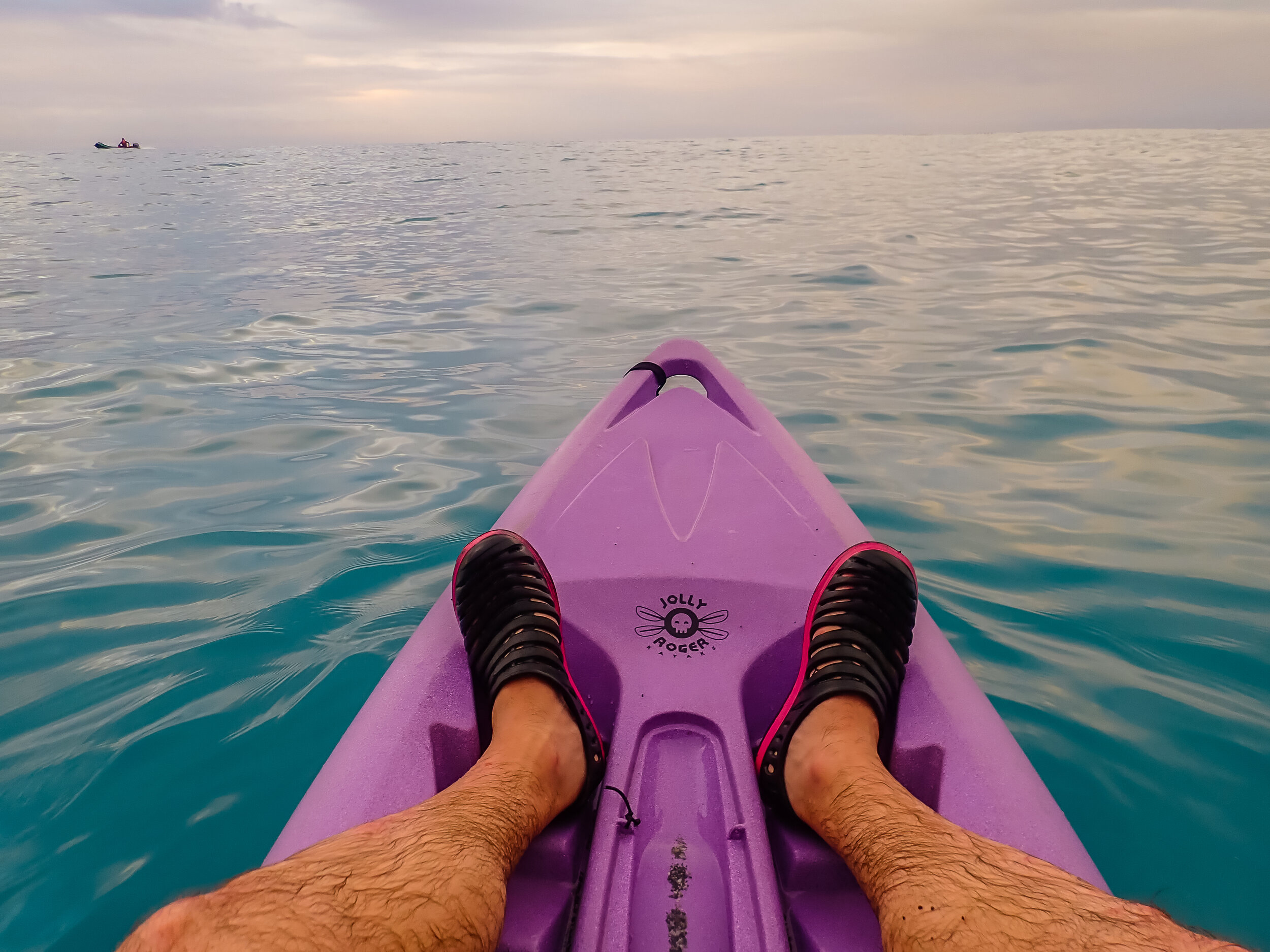
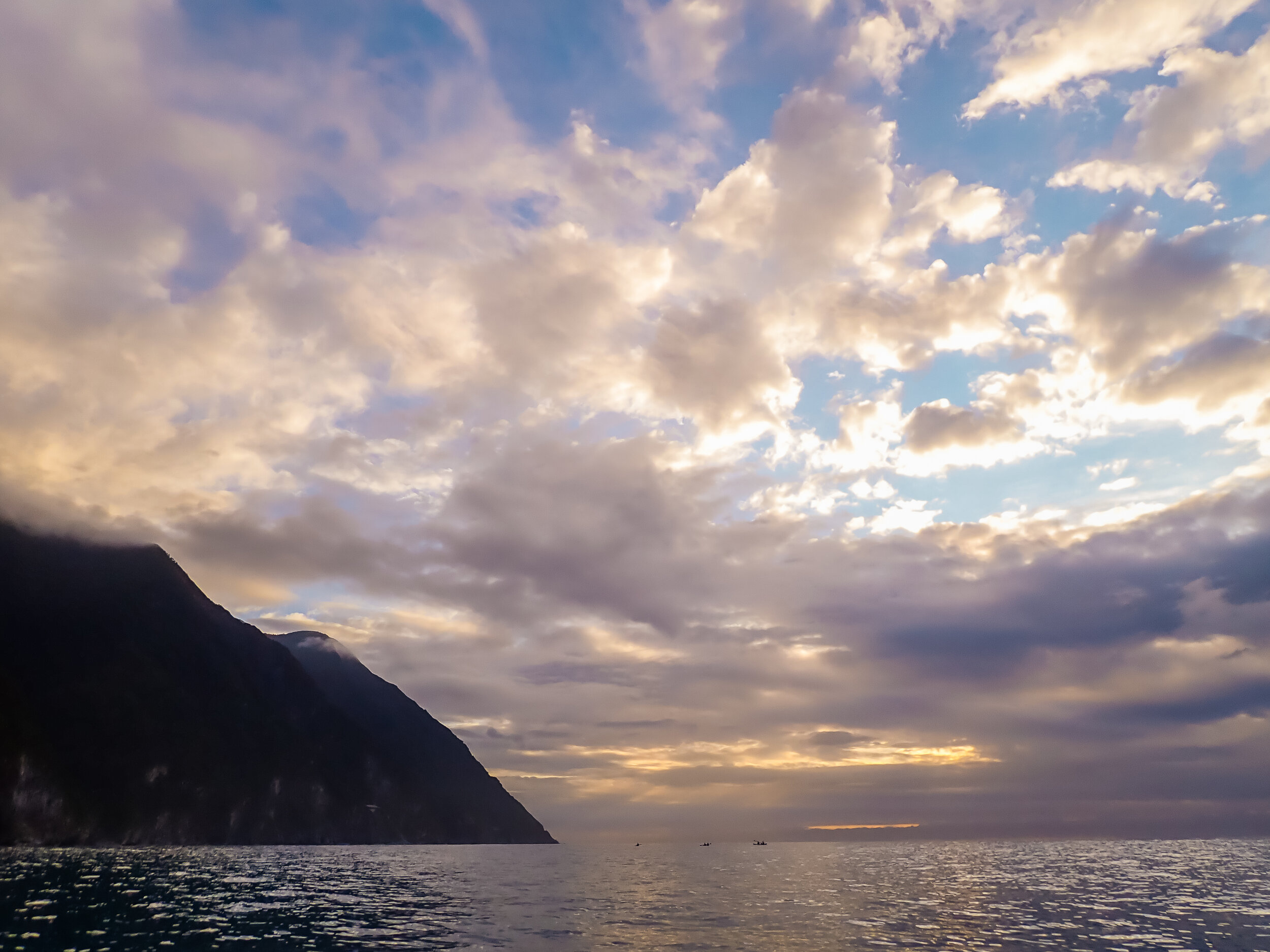
The colors were starting to poke out over the horizon, and it looked like a beautiful sunrise was on the way. Pleasantly surprised after weeks straight of plum rains, we got in the water and slowly made our way along the coastline.

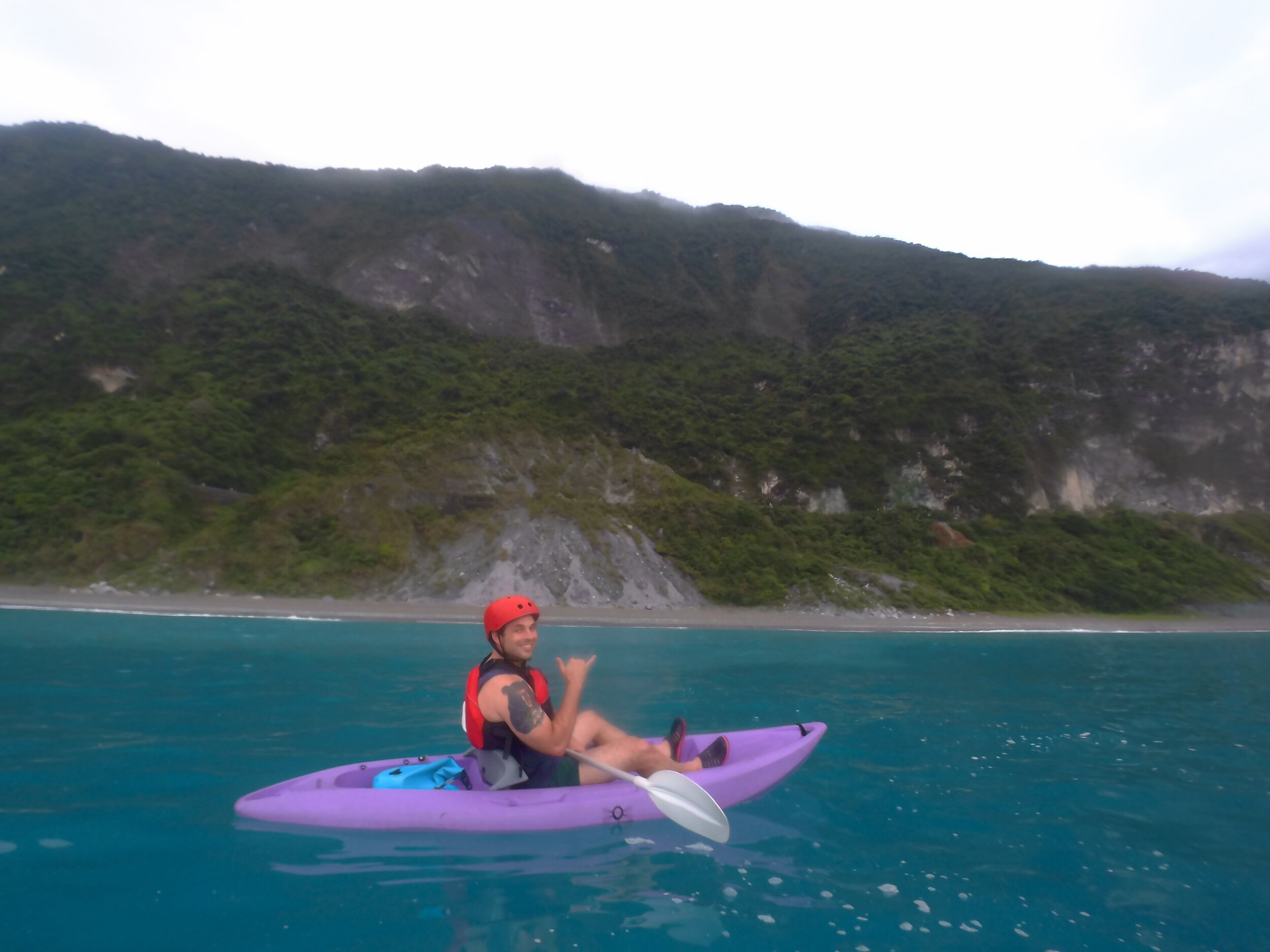
Now, I can’t stress this enough. Being in the Pacific Ocean, along the staggering cliffs of Taiwan’ east coast, is incredible. The ocean’s color varies as you move through it. I kayaked from a cloudy sediment filled milk-blue, to a tropical turquoise, to a deeper hue. The sky was opening up and the oranges and blues started to fill the sky as the big orange sun poked out over the horizon, leaving a gorgeous reflection seemingly pointed straight at us.

Me and Liber were casually cruising along, letting the larger groups race ahead so we didn’t have to be grouped in the cluster. It was a great time to just sit and take in the sunrise, in the calming movements of the ocean’s swells. I have to say I could not have enjoyed myself and my time in the water if I had been with one of those large groups. There is something very unappealing about kayaking in a group of 20 people who don’t know how to do it. Thankfully with Moonyak and my guy Liber, we avoided those big crowds and had the serene feeling of the ocean all to ourselves. As the crowds passed and the sun rose, we continued along the cliffs. The benefit of kayaking as opposed to SUP is that you can physically go further along the cliffs. We went practically to the ever popular viewing platform along the road, roughly 2km on the water. Along the way, while we were putting in the work to kayak, we noticed one group literally BEING TOWED TO THE END POINT AND BACK. This is what I mean. Why on earth would you sign up for a kayaking trip just to get towed by a boat while sitting in a kayak. That’s absolutely insane to me, insane that a tour provider would even consider doing that, and insane that customers would be content with that experience.
Again, I was so thankful to be with a tour provider who allowed me the full experience, and the freedom to go at my own pace.

One thing that was pretty cool to see was a landslide on the cliffs, all the way down to the beach. Apparently there was an earthquake, as there are every day in Taiwan, and the rocks broke free above. We sat from our kayaks and watched the rocks tumble down the cliff towards the beach. They landed with a big THUD, and all we could think about was the brilliant idea to close the old Su’Ao highway and bore tunnels instead.

We made it to a few rocks jutting out at the base of the Qingshui Cliffs and turned back around. The water was choppier there, and if we had gone any further it would have made for some rough kayaking. We took our time heading back, jumped off the kayaks and took a swim, marveling at our surroundings and how stunning they were.
As we got back to the beach, we rode the waves into the shore on our kayaks. My attempt wasn’t graceful, I almost flipped over, but it was good enough to get safely on the shore. All in all the trip was about 3 hours and well worth the early wake up. EARN THAT SUNRISE!
Overall this was an amazing experience, and the people at Moonyak, especially Liber, were awesome through the whole process. It’s a tough call to choose between SUP and kayaking along the Qingshui Cliffs, so I encourage you to give both a shot and make the decision yourselves!

FOR THIS FUN TRIP AND MORE AROUND TAIWAN, CHECK OUT OWLTING EXPERIENCES
FeiCui River (翡翠谷)
Hualien County, Taiwan

Hualien County is one of Taiwan’s most beautiful areas, with tourists visiting daily to explore Taroko Gorge. While a visit to Taroko is a must, in the summer heat there is a real need to enjoy beautiful swimming holes and rivers in Hualien County.
Enter FeiCui Valley (翡翠谷), south of Hualien city, in the aboriginal Truku land. Crystal clear waters flow through massive marble boulders, past waterfalls, and into a perfect natural swimming hole. FeiCui stream offers gorgeous river tracing perfect for beginners, and one of the best natural swimming holes around. River tracing isn’t necessary, as there is a quick trail leading 90% of the way up to the swimming holes.

Starting in Hualien, on the East Coast of Taiwan, you will have to drive roughly 30 minutes south towards the Truku land. I prefer to take a scooter, because it’s such a pretty ride, and with a scooter you can take the back alleys through farmland. When you arrive at the bend you have to park and begin walking an old dirt road initially built for hydroelectric farming of the region. Be sure to bring your phone or a flashlight! The road leads to a man made rock tunnel, full of uneven footing!
The FeiCui stream starts with a man made waterfall, where you’ll find locals relaxing and barbecuing, however the real beauty is above, so continue up to a natural swimming hole and ultimately a gorgeous waterfall.

Once you reach the swimming hole FeiCui is known for, you can either chill here for the day or continue up to Zimu Waterfall (字母瀑布). If you choose to do so you can take the path on the left of the swimming hole, or you can go straight up the river, which is much longer and more difficult.

FeiCui Valley (翡翠谷) is a stunning location and one of my favorite places in Taiwan to enjoy a hot summer day. If you’re in the Hualien area and need a break, I highly recommend checking it out!

How to Get There
Top 5 Adventurous Day Hikes in Taiwan

Taiwan is a country with a vast network of trails. Spanning coastal views and dense forests, up in the high mountains or down in the valleys, Taiwan’s hikes will allow you to see the best the country has to offer. Here we will focus on day hikes that are both easy to access and are on the more adventurous side!
The Top Five Adventurous Day Hikes in Taiwan
5. Huang Di Dian (皇帝殿)
There’s no better hike to get your blood pumping and calves burning than Huang Di Dian (皇帝殿). Just outside of Taipei, is a fantastic day hike. Huang Di Dian starts in the quiet town of Shiding, climbing an intimidating staircase and high ladders to the seemingly perilous ridges above. Huang Di Dian starts off this list due to the exposed ridge walks, large ladder climbs, and the final chain ascent, which at roughly 60% grade is no small feat! This trek is not for the faint of heart, but what good adventure really is?

4. Wuliaojian (五寮尖)
Thought of as the big brother to Huang Di Dian, Wuliaojian (五寮尖) is one of the best, most interactive day hikes around Taipei. Start your trip climbing steep slopes and up rugged terrain towards the many peaks which give way to a perfect 360 degree panorama. While you take in the views, descend down treacherous ridges, including the near vertical 30 meter rope descent. Chance seeing monkeys and other intriguing wildlife along the way as you continue. Wuliaojian’s rope climbs, descents, and narrow ridge lines leave a lasting impression on hikers. As you finish, you will want another round!

3. Zhuilu Old Trail (錐麓古道)
Taroko Gorge (太魯閣國家公園) is one of Taiwan’s nine spectacular national parks. None of the day hikes within Taroko are more adventurous than Zhuilu Old Trail (錐麓古道). The trail winds up the mountain, over gaps and suspension bridges, until reaching the old “cross mountain highway”of Taroko. The 500 meters of white knuckle cliff hiking is 1100 meters above the Liwu River. The narrow cliffside of Zhuilu Old trail was used by aboriginal tribes to reach the western side of the Gorge, near Hehuanshan Mountains, until the Japanese invaded and used the same trail to attack and take over the local tribes. It was then turned into a Japanese tourist attraction. Now it is a wonderfully exciting hike, with a required good head for heights, that offers the most spectacular views from within the Gorge.

2. Yuanzuishan (鳶嘴山)
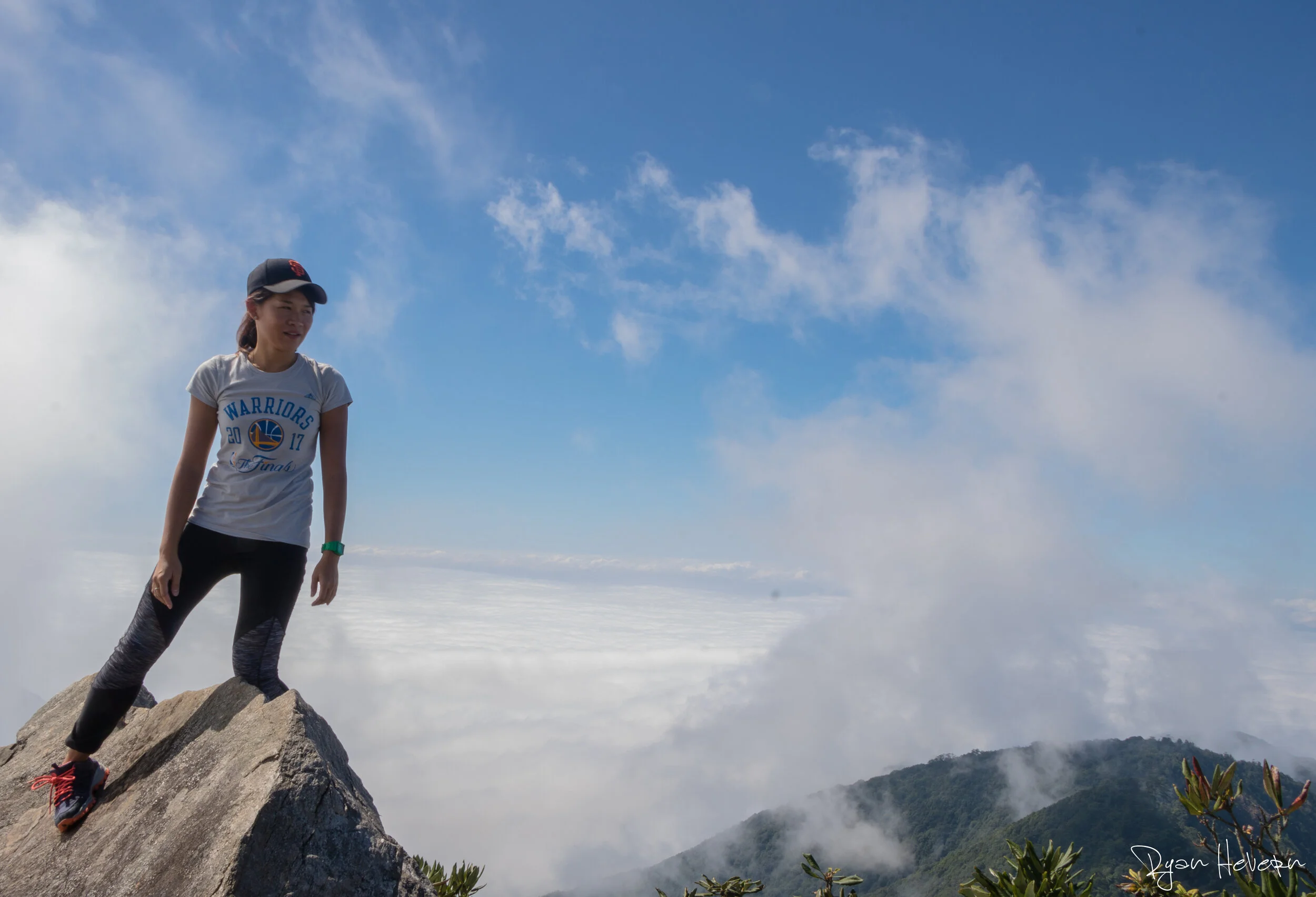
Yuanzui Mountain (鳶嘴山) is a fun, interactive climb. This adventurous hikes allows hikers to stand above the clouds and take in views of the iconic Jade Mountain in the distance. The Yuanzui Mountain experience is incredible. Pine forests, ridge-line walks, and rope climbs while on this exciting excursion will keep your heart racing. What starts as a straight forward set of stairs quickly turns in to a massive climb up ropes and tricky cliffs. Hair raising, vertical cliffs are the pathway down the backside of the mountain, where you’ll be tested on any fear of heights that might be deep down!
1. Stegosaurus Ridge (劍龍稜)
Stegosaurus Ridge (劍龍稜) is quite possibly the finest day hike in Northern Taiwan. Steg Ridge is also THE MOST adventurous day hike in Taiwan. Think hiking with a hint of bouldering and balance beams.
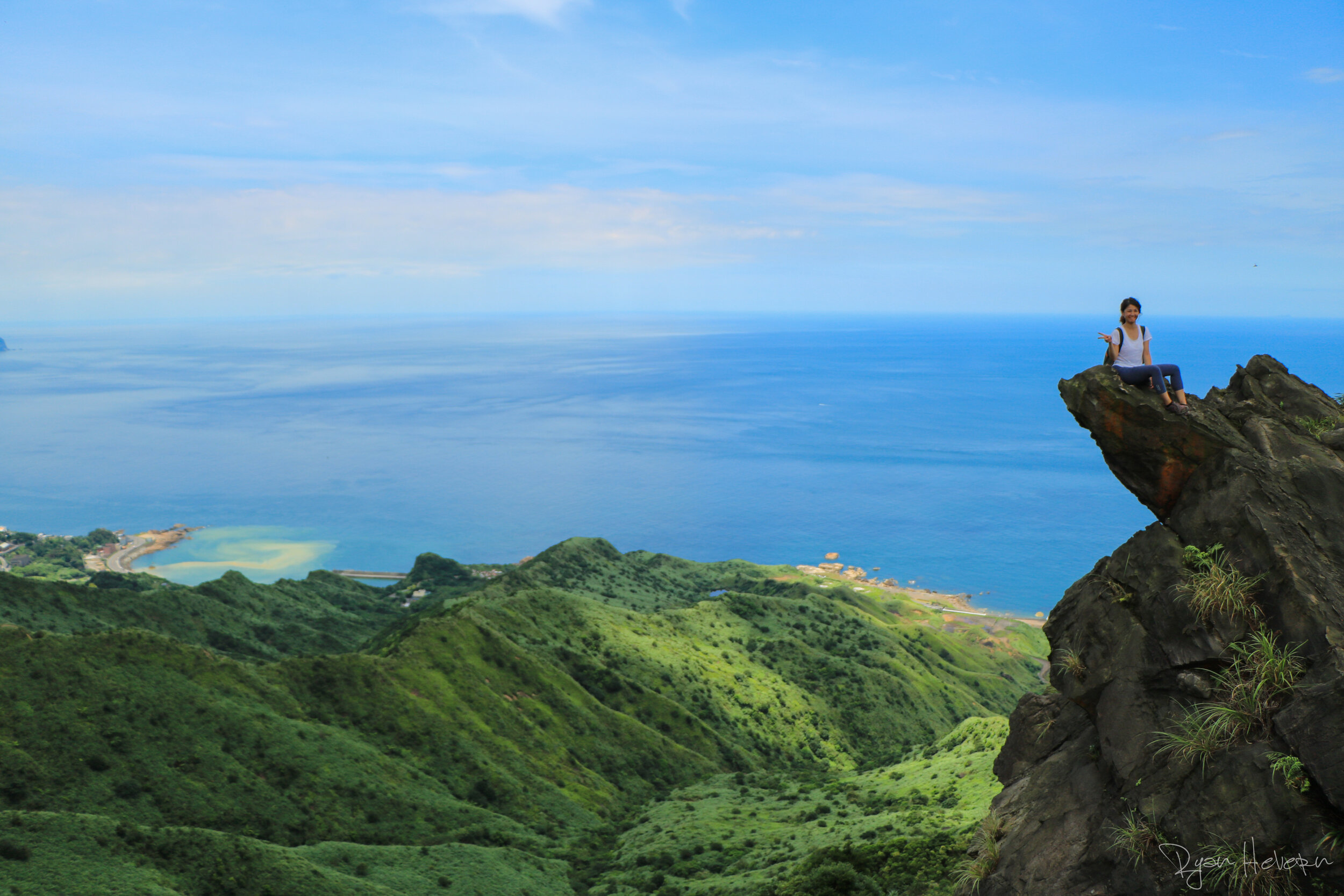
Hikers will spend a solid hour maneuvering through head high silver grass before balancing and scrambling up a ridge line with sheer drops on either side, with no trail!The knife ridge sticks out above an abandoned copper mine, the blue coastline and links up to Teapot mountain. Scrambling over the trail-less ridge line is exhilarating and challenging, with the opportunity to stand over the cliff on Buddha’s Tongue for a picture perfect moment of excitement.
Stegosaurus Ridge is bound to get your adrenaline pumping from start to finish!
Snakes in Taiwan: A Quick Rundown!

Spring is in the air! As the weather heats up and the spring rains come, the flowers bloom and the fauna emerges. Spring time is one of the most enjoyable seasons for hiking in Taiwan, as the ecological diversity is on full display. One of Taiwan's inhabitants emerging from the cold winter are the abundance of snakes! Don't be deterred, as this post will run through some common snakes in Taiwan, and what to do when you come across them.
Snake Encounter DO'S and DON'TS
DO:
It can be quite common to come across a snake while hiking the vast trails in Taiwan. If you happen to encounter one, stay calm and give it some room. Snakes generally feel your vibrations ahead of time and will slither away accordingly. If they do not, try stomping your feet from a distance to encourage it to slither away. If there are no other options, carefully move around it yourself.
DO NOT:
Do not prod at it with a stick, throw rocks, or disturb it in any way. This will only agitate the snake and increase the previously slim chance of catching a snake bite. The general rule of thumb is snakes can strike at half their body length. While side stepping it, make sure to give yourself at least double or triple that distance.
DO:
Keep an eye on the trail ahead of you. If you are hiking in tall grass be sure to look down while walking. In order to give yourself the chance to enjoy the whole of the scenery around you, bring a walking stick to help move the grass and deter snakes.
DO NOT:
Walk blindly over fallen logs, into tall grass, or any other obstacles a snake might want to relax under. Keep your eyes out for snakes under large piles of wood.
DO:
Wear appropriate clothing. It isn't ideal to walk through tall grasses, jungle forests, etc, with flip flops on. Be advised long pants and sturdy boots are the best defense against a snake getting frisky.

Treatment
In the case of a snake bite, one rule is very essential: Stay calm. Keep your heart rate low and look to evacuate the area and seek the nearest hospital or clinic.
Venomous snakes can inject one of three types of venom: Hemotoxins, Neurotoxins, or Myotoxins. Different snakes will require different anti-venoms. In order to identify the snake, take a picture, or mental notes. DO NOT try to catch it, cut off its head, or anything that will lead to more bites.
DO NOT try to suck out the venom, cut around the bite area, or anything you may have seen in the movies. Take off all jewelry and tight clothing or accessories to allow for swelling.
If you are close to a trailhead, slowly make your way out and seek help immediately. In the instance you are far from the trailhead call Emergency services and get an evacuation. If there is no cell service, have a friend hike out or hike up and seek help.
Again, it is important to stay calm, limit your movement, and seek help immediately. Taiwan keeps good stock of anti venom in clinics and hospitals.
To help limit your movement, create a splint around the affected bite area. Do not make it too tight as the limb will swell. This will help you keep the affected area as still as possible while you seek help
Night Hikes!
If you are interested in learning more about the various species of snakes in Taiwan, contact us for one of our Wildlife Night Hikes! We will explore the jungles and streams of Taiwan, often coming across many snakes, endemic amphibians, civets, flying squirrels and more. The purpose of our night hikes is to educate adventurers on the flora and fauna surrounding them. The more you know, the better prepared you will be when you encounter one of these reptiles in the forest! We hope to see you soon!
Common Snakes in Northern Taiwan
Taiwan Habu 龜 殼花 (Brown Spotted Pit Viper)
The Taiwan Habu is highly venomous, and can be spotted camouflaged in with leaf litter on the forest floor. Look for the triangular head, brown diamond like scales on the back with yellow outlines. The Habu is active at night, and hiding under logs or rocks during the day.

Bamboo Pit Viper 赤尾青竹絲
The Bamboo Pit Viper is Taiwan’s “feared” green snake. Active at night, you will spot it slithering around vines and tree branches. This snake is venomous, and can be spotted by the triangular head, red eyes, and red tail.
Greater Green Snake 青蛇
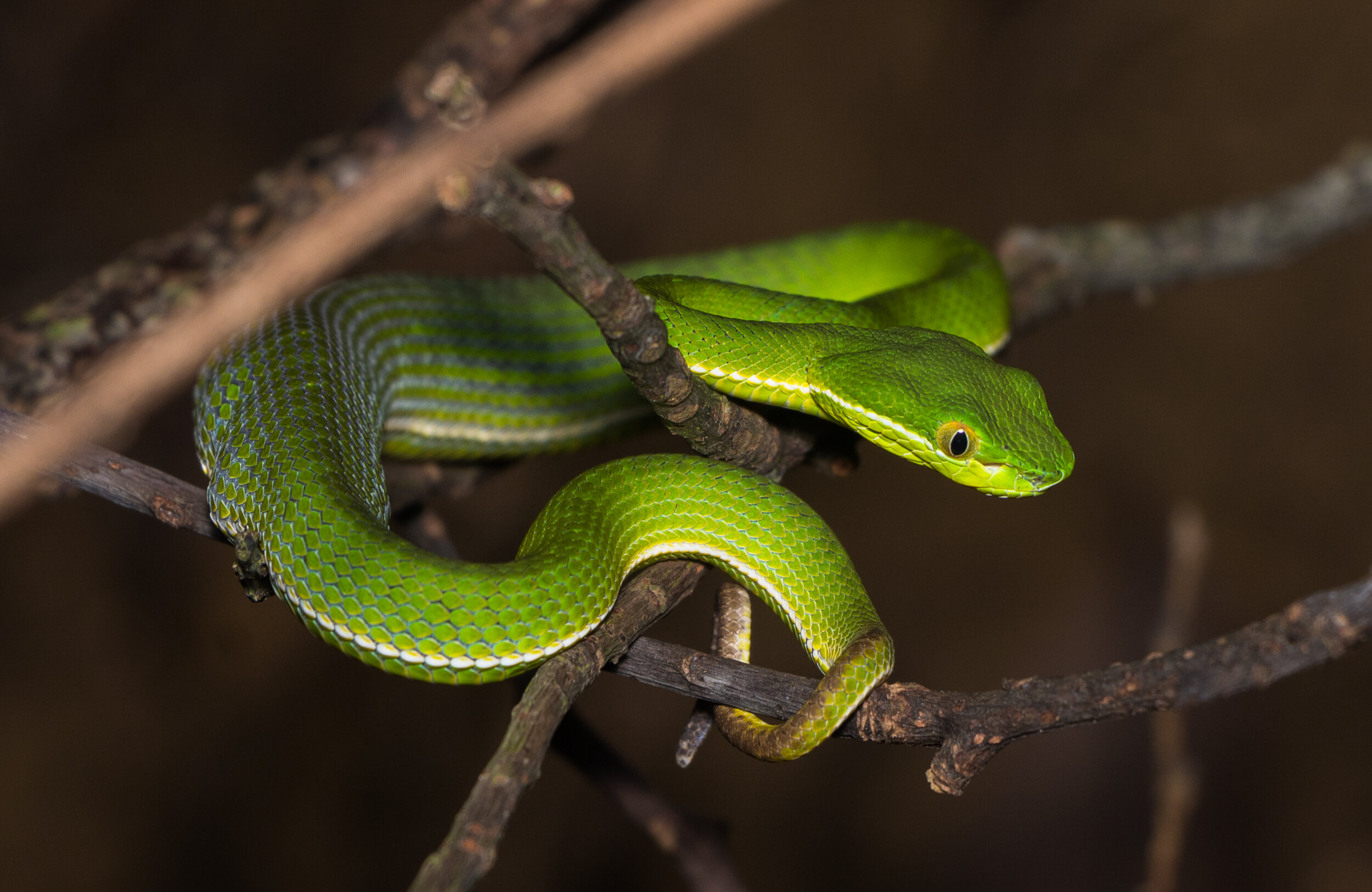
The Greater Green Snake is Taiwan’s “other” green snake, the Non-Venomous kind! You will find this snake perched on tree vines and branches at night, sleeping. You can differentiate the Greater Green Snake from the Bamboo Pit Viper by the shape and size of the head, and the tail color. The GGS is very vibrant, glossy, and a treat to spot!

Square-Headed Cat Snake 大頭蛇
The Square Headed Cat snake is mildly venomous, mostly nocturnal and mostly arboreal. The body is long and slim, and it is a rear fanged species. The Cat Snake gets its name from the cat like pupils.

Red-Banded Snake 紅斑蛇
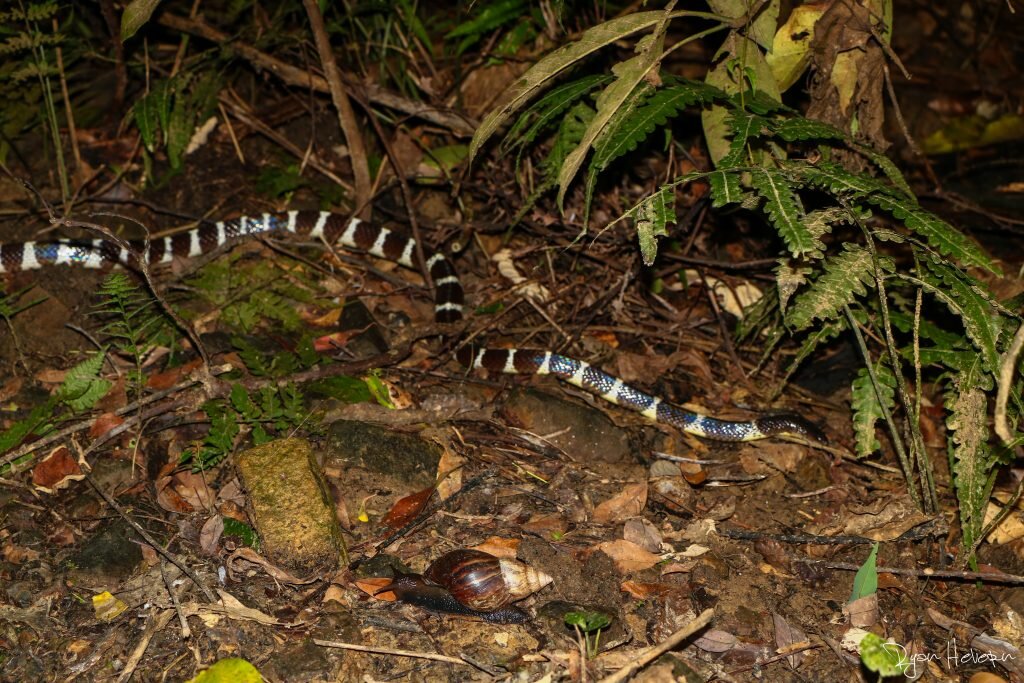
The Red Banded Snake is non venomous, and one of the most common nocturnal snakes in Taiwan. This snake is known for its defensive nature, and will readily bite if disturbed.

Many-Banded Krait 雨傘節
The Many-Banded Krait is highly venomous, and can be quite common while hiking at night in humid areas. The Many-Banded krait is not aggressive unless provoked. In most encounters the snake will freeze or flee to avoid any interaction. Be careful and do no disturb this snake, as you have to go to Australia to find a more venomous bite!
Night Hikes in Northern Taiwan: Common Reptiles & Amphibians
A field guide for all adventurers is available for Kindle and Paperback!
WATCH: 10 Most Common Snakes in Taipei
How to Travel Responsibly
How to Travel Responsibly
Traveling abroad is important for many reasons. Personal growth, broadening your horizons, building self confidence, and more. Your travels abroad should also benefit the communities you visit. Make sure to travel responsibly on your next trip. Below are some pointers on how to do so.

Tips on How to Travel Responsibly
Before Traveling
Find out as much as possible. The more you know about an area before arriving, the more the area will come alive. Look into the area’s history, culture, natural environment, customs, legends, advisory notices and more.
Learn a few words in the local language. Making an effort to speak the local language allows you to interact with the people who know the site best. People appreciate your efforts and your interest in learning. Simple words like ‘Hello’, ‘Please’ and ‘Thank you’ can go a long way.
Pack light. It is tempting to pack everything you think you might need, but remember to be smart about your necessities. Packaging items like the paper box to your film or the plastic wrapping of your new toothbrush simply consume space in your bag and can create excess trash for local area.
Lodging choices. Look for hotels that have a written policy covering their environmental impact, employment and cultural policy.
Explore transportation options. Remember that traveling affects the environment. Wherever possible, try to minimize your pollution and impact on the environment by looking to alternative transportation and off-setting your carbon emissions.
While Traveling
Engage in local culture. The saying, ‘While in Rome do as the Romans’ still applies today. Your trip provides a unique opportunity to explore a new culture and to see the world through a different perspective. Remember that eating local foods, shopping in local markets, and attending local festivals are all part of experiencing the culture.
Buy local products and services. Choosing to support locally owned businesses, community tour operators, and artisans means that you’ll have a one-of-a-kind experience and your money will go directly to the community. Before purchasing goods, ask about their origin. Avoid buying products made from threatened natural resources and report poaching and other illegal activities to the local authorities.
Refrain from aggressive bargaining. It’s often difficult to know your limits in bargaining so if you’re not sure, ask your local hotel for tips. Remember that the purchases you make directly affect vendors’ livelihoods, so decide if you really need to hang onto that extra dollar or if it could impact the vendor more.
Hire local guides. Enrich your experience by choosing local guides who are knowledgeable about the destination. Ask local tour operators and hotels for good recommendations.
Tread lightly. Destinations are exceptional due to their natural or cultural splendor. Do your part to keep them that way by following designated trails, respecting caretakers, and not removing archaeological or biological treasures from sites.
Respect the natural environment. Reduce, reuse, and recycle. Even though you are just visiting and not paying the utility bill, disposing of your garbage properly and minimizing your consumption of water and energy will benefit the overall destination.

After Traveling
Distribute your responsible travel tips. In addition to telling family and friends about the wonderful memories you made, also consider sharing tips on how they too can positively impact the World while having an amazing journey.
Share your photos. Pictures can say a thousand words.
Explore more. Traveling is just the start of learning. Once you return home continue exploring and being involved with the issues or region that captured your attention. Build upon your knowledge and also learn about another fascinating place.
Give back. Traveling often opens your eyes and heart to something new. You can continue to preserve inspirational areas for generations to come by making a donation to a local charity.
Options will vary in each country you visit. Rest assured though, as you can always choose to travel responsibly on your next adventure! We hope to see you in Taiwan for your next trip abroad. We promise to ensure you travel responsibly.
Hehuanshan 5 Peaks and How to Climb Them!

Five of Taiwan’s most accessible top 100 peaks lie in Central Mountain Range of Taiwan. The Central Mountain Range lies on the border of Nantou and Hualien counties. Due to it’s unique position, Hehuanshan is a gorgeous location to hike the high mountains, camp, and view some of Taiwan’s history. There was once an operating ski lift on the East Peak, which the remnants are still visible.
DAY 1
I would recommend leaving Taipei at 6:30am due to the 4 hour drive down south, towards Nantou County. On the way you will drive through Puli and into the mountains of Hehuanshan. The highway is the only paved road across the Central Mountains, connecting Taichung to Hualien via Taroko Gorge.
On arrival there is ample parking near the North Peak trailhead. However if you want to first ascend the three easier peaks, all above 3,000 meters, you can park next to the 3158 Cafe. The East peak (3,421m), Shimenshan (3,237), and Main peak (3,417m) all lie within reach of the parking lot. East Peak being the longest hike at roughly 2 hours round trip, Shimenshan being the shortest at 20 minutes.

After bagging these easier peaks, grab your gear and trek roughly 2 hours to the campsite near North Peak. The campsite is just below North Peak. You will come to a junction, and take the path down the mountain to the right. Other campers and their tents will be in sight from there. After setting up camp, cook up some dinner and take in the beautiful sunset from high in the mountains.

DAY 2
Wake up early for sunrise over the mountain peaks. After taking in the view take your day pack and conquer North peak (3,422m) and West peak (3,145m). This is a strenuous day, totaling roughly 8 hours of hiking. The hike traverses over the the mountain ridge, with plenty of cliffs, ups and downs, and beautiful forested areas along the way. Upon conquering the North and West peaks, you will have topped 5 of Taiwan’s Top 100 mountain peaks above 3,000 meters!

It’s a long drive back to Taipei, so there are options to spend the night in a hotel nearby, or if you have your own vehicle you can continue driving to Hualien and Taroko Gorge.